
I recently had the honour of chatting with Lisa Hope Tilstra on the Make Life Less Difficult podcast. To quote her purpose, “This podcast explores what it means to make life less difficult for each other and for ourselves. We share stories of struggles and successes because we believe sharing our stories eases the difficulty of life.” This really spoke to me because as an editor and writing coach, my role is all about helping people tell their stories. I tried to articulate for Lisa how I help authors and subsequently wrote this post to capture those ideas.
When a client approaches me for help with their book, I need to understand their motivation and goals. The why, what and how of their story:
- Why do they want to tell the story?
- What do they want to say?
- How might they say it?
This may sound obvious, but it’s easy to dive into what is already on the page without considering these parameters. If I’m working with authors who are clear about their goals, I don’t spend much time on this, but for new authors who are feeling their way, a more extensive discussion may be useful. Why spend years writing a book when a blog or a podcast would accomplish the same objective with more immediate results? If someone is using writing as a form of therapy, do they need to publish or is it enough to put words on the page? If publication is important, are they happy to self-publish or do they crave a traditional publishing deal? What is their key message? The answers to these questions, and more, influence how a story is crafted.
To stimulate this type of discussion, I’ve developed a couple of charts: one to discuss an author’s motivations for writing, and another to examine their content. Of course, these are simplifications. People are complex, so rarely do our motives and goals fit into neat little boxes. These charts are conversation prompts rather than absolutes. Many of us have more than one story to tell, and our answers may vary for each of them.
Let’s start by considering motivations for writing, both financial and personal. Note, more than one answer may apply to the same project.
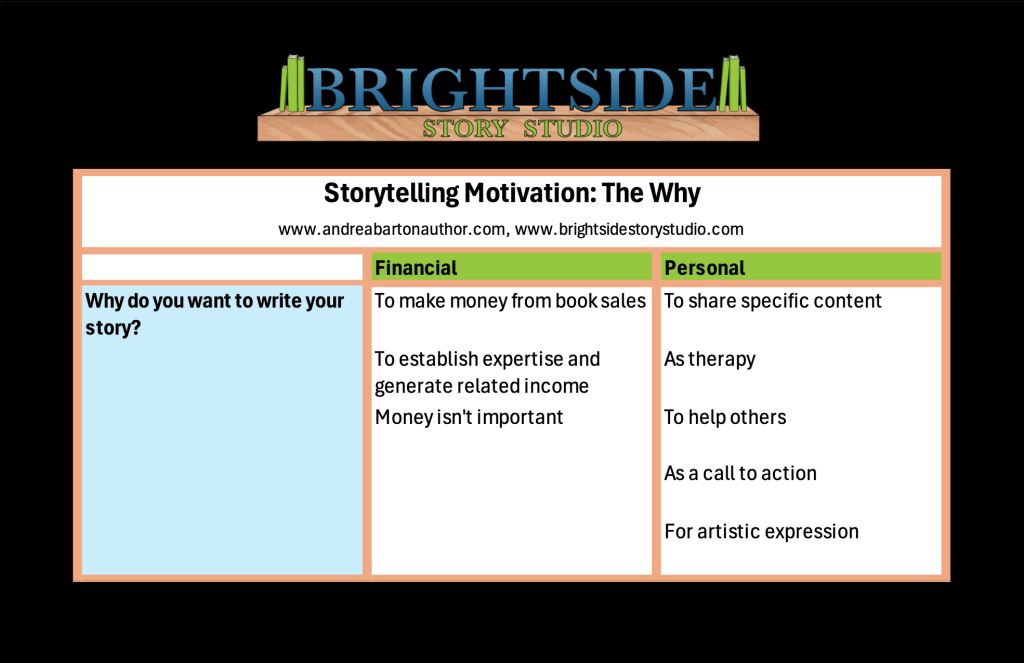
Let’s start by discussing a writer’s financial imperatives. A person may hope to make money directly from book sales or indirectly from the expertise they generate from publishing. i.e. Rather than the author selling the book, the book sells the author – their product or services. But money isn’t critical for everyone. For some, telling their story is enough, even if it costs them money to do so.
The sad fact is that most authors don’t make money from their books. The path to publication is long, arduous and can be costly. Veteran authors understand how long the editing process can take. Novices often don’t fully appreciate that. I don’t like to curb anyone’s enthusiasm, but a dose of reality may help to set more achievable timeframes and objectives.
Regardless of an author’s financial goals, they will likely also have personal motives. These can be as diverse as wanting to help others, to help themselves as a form of therapy, to share specific content, as a call to action or for artistic expression – art for the sake of art. Taking the time to understand these underlying reasons for writing can help to form the best path forward.
With these objectives in mind, the next thing to consider is what an author wants to say. Consider this chart.
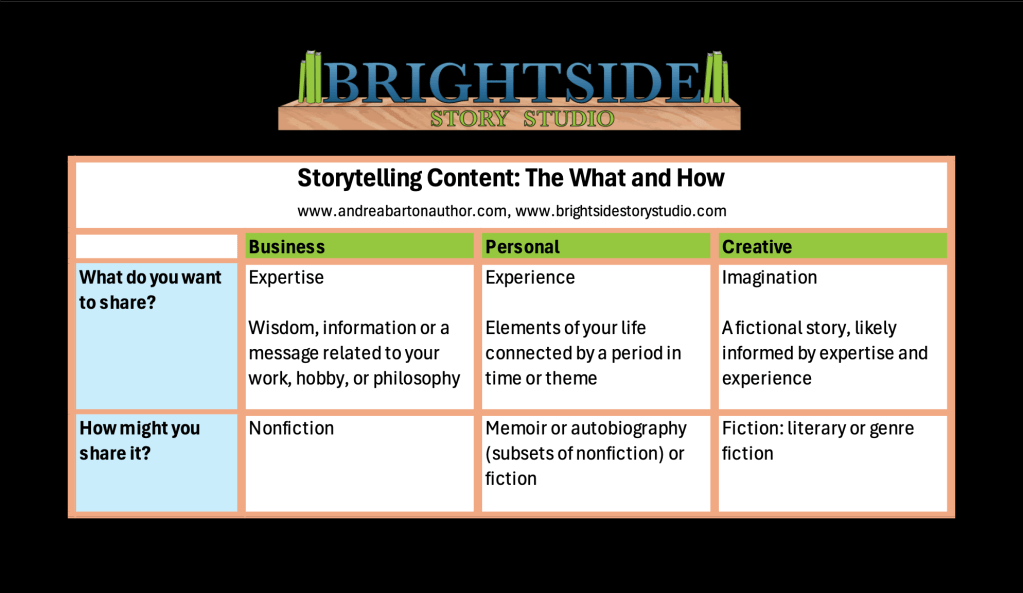
I’ve separated content into business, personal and creative. Of course, some material will straddle more than one, if not all categories, so when deciding how to tell the story, focus on which fits best.
In business writing, the author shares their expertise in a field, whether that’s leadership, knitting or renewable energy. They are not writing for the sake of writing, but to impart wisdom, information or a key message. It can be work-related or hobby-related. Typically, this is written as nonfiction.
Personal writing is driven by the author’s experience and their need to make sense of the world. It will often share a key message or learning. Usually, it’s written as an autobiography or memoir, but it can also be fictionalized, especially if the author is cautious about naming actual people or events. I’ve written more about memoir, including the distinction between it and autobiography, in The Pros and Cons of Writing Memoir.
Creative writing is fueled by the imagination. Whether it takes the form of literary fiction, genre fiction, poetry or a film script, the writing is the product. There is often a strong overlap between this and personal writing, as the themes and other story elements that emerge are usually driven by personal experience and the author’s ideology. For example, the death of my mother fed into the theme of grief in my mystery The Godfather of Dance, although I didn’t write directly about her.
I’ve kept these charts as simple as possible, but hopefully, the discussion they stimulate can be wide-ranging and in-depth to help writers plan their projects more effectively. I hope my readers find it useful. If you pick up anything I’ve left out or have any other suggestions for improvement, please go ahead and drop me a note in the comments, or use the contact form on the Brightside Story Studio website.
I’ll post the podcast I recorded with Lisa when it goes live. In the meantime, check out her other episodes here or on your favorite podcast channel and think about how you make life less difficult for others, whether through storytelling or some other way.
Next time: I interview Diane Clarke on wartime evacuation and her novel, The Photograph
Next writing blog: Writing a Mystery: Crafting a Series
 Brightside Story Studio
2 thoughts on “The Why, What and How of Storytelling”