
For 2026, I’m trying a new approach to interviews on my blog so I can feature more authors. Rather than speaking to one person about their book, I’ll pick a topic and ask for many authors’ views. Let me know what you think.
My January topic is Writing Habits, and thank you to these wonderful authors for taking part in this experiment: Sarah Bourne, Letting Go; Sarah Hawthorn, Love. Camera. Action.; Dani Netherclift, Vessel; Lisa Darcy, Lily’s Little Flower Shop; and I’ve answered too.
In author interviews, we are frequently asked about what our workplace looks like, what our routine is, whether we have any quirky habits and more, so take a look at what we five had to say…
Where do you write?
I write on my laptop in the lounge on my favourite sofa which is very comfy and close to the kitchen to make tea! (Sarah Bourne, Letting Go)
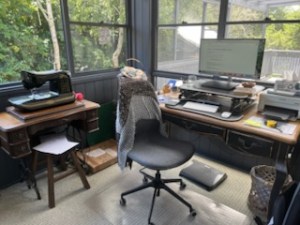
Mostly in my study, because I can set up my laptop with a large screen monitor, which is super-helpful for viewing up to three files at once – my WIP, plot/edit notes and research. But I can happily write anywhere, and often find I’m more creative when I work in a cafe, at the airport, on a train, in a hotel room, the garden. The change of scenery seems to act as a productivity boost. (Sarah Hawthorn, Love. Camera. Action.)
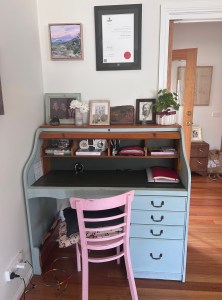
I usually write at my writing desk. I’ve just moved, so the desk used to be in a designated office room but is now in the living room. Sometimes, I do my best writing in my bed. (Dani Netherclift, Vessel)
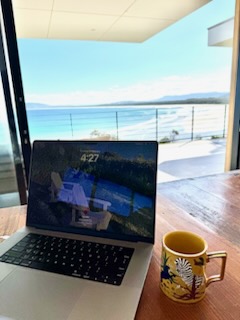
I write at my dining room table, overlooking the ocean. When I’m procrastinating, I tend to move about the house, following the shade in Summer and the sun in Winter. (Lisa Darcy, Lily’s Little Flower Shop)
I can’t stay in one place for too long, so I move between the kitchen table, the couch and a stand up desk in my bedroom. (Andrea Barton, The Godfather of Dance)
When do you write?
When I’m in the zone I write every spare moment I have. Otherwise I try to do at least a few minutes a day, even when the muse has deserted me. (Sarah Bourne, Letting Go)
Usually from late morning to early evening. Mornings are given over to procrastination. Evenings are family time, but also 4-6 hours is about my daily limit before I start getting bug-eyed and brain fog. (Sarah Hawthorn, Love. Camera. Action.)
I have school-aged children, so during school terms, I drop my youngest at school, then do some household chores and I like to be sitting down at my desk by 10 or 11 and then I get to work. (Dani Netherclift, Vessel)
I don’t have a set routine like I did when my three children were at school. Generally, the ‘when’ is dictated by deadlines. I don’t use writing software, just my trusty Microsoft Word, which reminds me, I need to back up my hard drive. (Lisa Darcy, Lily’s Little Flower Shop)
When I’m not working on a client edit, I work office hours on my writing. (Andrea Barton, The Godfather of Dance)
What writing software do you use?
I write in a word document, usually just the one – although in the past I have written chapters out of order and put them in separate docs. (Sarah Bourne, Letting Go)
Scrivener every time. I reckon it saves it me hours, even though I probably only use a tiny percentage of its capabilities. (Sarah Hawthorn, Love. Camera. Action.)
I just use Word. My writing is usually nonfiction, and carefully formatted in a bespoke way that includes archival images, so people have said that this is all undone in programs like Scrivener when you try to bring it over to Word. If I was working on a traditional novel, I would utilise Scrivener. (Dani Netherclift, Vessel)
I use Word. I setup a document for the book and a separate one for notes to keep track of character details, timelines and other relevant information. (Andrea Barton, The Godfather of Dance)
Do you use any rituals when you write?
I don’t have rituals, but I do have a favourite pen for when I’m making notes in longhand, which I do because I love the act of handwriting. It never feels quite right if I don’t have my special pen. (Sarah Bourne, Letting Go)
Not that I’m aware. (Sarah Hawthorn, Love. Camera. Action.)
Can’t say that I do. (Dani Netherclift, Vessel)
I wear Air Pods, not to listen to music but to block out noise. Apart from white noise, I like writing in quiet. Now and then, I light a citrus scented candle and drink peppermint tea. (Lisa Darcy, Lily’s Little Flower Shop)
When I’m writing Jade Riley material, I wear a jade necklace and ring. (Andrea Barton, The Godfather of Dance)
What are your best procrastination techniques?
My best procrastination techniques are online word games and ‘research’ – i.e. going down rabbit holes and finding myself in areas that have nothing to do with my book but are fascinating! (Sarah Bourne, Letting Go)
I don’t need any techniques, procrastination comes naturally! (like writing this) (Sarah Hawthorn, Love. Camera. Action.)
Oh, you know, the usual things—the imperatives of doing the washing and the housework, as well as some very important doom scrolling. (Dani Netherclift, Vessel)
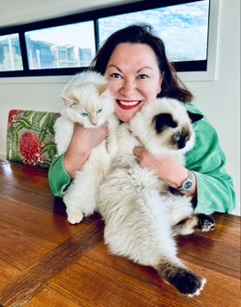
Let me count the ways. I read, vacuum, annoy my cats, walk, garden, doom scroll, and lie on the couch moaning about my inability to write … the list is endless. (Lisa Darcy, Lily’s Little Flower Shop)
Doomscrolling on social media. (Andrea Barton, The Godfather of Dance)
What are you best strategies to get over procrastination?
Best strategy to get over procrastination is turning the internet off! (Sarah Bourne, Letting Go)
I aim to get all my chores and errands done in the mornings so my day is then clear to focus. Fear helps too – looming deadlines are always good for ensuring everything else takes second place. (Sarah Hawthorn, Love. Camera. Action.)
I read or listened to an interview with Kate Mildenhall before Christmas last year, and she said that she used a technique where she set a timer for 8 minutes, and during that time, she wasn’t allowed to get up off her chair, or so anything that wasn’t writing. She said it generally only took that long to get her into the rhythm of writing, and if not, she reset the timer, and rarely had to do so again. Kate’s technique has been great for me. I set the timer for ten minutes. It’s so good for getting you into the sweet spot of focus and immersion in the task. What’s so funny about this is how we seem so obstinately hardwired to procrastinate, even though, as writers, we thrive on the task of actually doing the work of writing. Anyway, I highly recommend Kate’s technique if you have trouble getting going. (Dani Netherclift, Vessel)
I’ll eventually force myself to read over a scene and add another 500 words leading on from there. Basically, I focus on sub plots or characters, rather than the entire 80,000 words. That way I can tackle part of the manuscript and convince myself I’ve succeeded at a manageable task, rather than an onerous one. (Lisa Darcy, Lily’s Little Flower Shop)
Have a ‘writing sprint’, where I turn off phones and socials for a set period of time and just write. (Andrea Barton, The Godfather of Dance)
Please give one piece of advice to help authors develop good writing habits.
I often stall at scenes I think are going to be difficult to write, or that I don’t want to write. I let myself have a couple of days or procrastination, then I make myself sit and tackle the scene. Having even a few words down then feels like an achievement, and it gives me something to work on. I can honestly say, it’s never as bad as I think it’s going to be! (Sarah Bourne, Letting Go)
Approach your writing like a job with set hours and stick to it. Be realistic about how much you can expect to write in a day. There’s little point aiming for 5,000 words when generally you only manage 500-1000. And when the words just won’t flow, go for a walk to refresh the brain, or spend your day editing instead. (Sarah Hawthorn, Love. Camera. Action.)
Remember how lucky you are to be sitting down and doing what you love. If you don’t love it, maybe take up another task, instead. (Dani Netherclift, Vessel)
I recently wrote a short crime/murder story (25,000 words) for a relative after an idle promise made after a few wines at her birthday celebration. I discovered that writing a completely different genre, without any expectations, was very enjoyable. Despite being well out of my comfort zone, I wasn’t concerned about editors or publishers, so I allowed the narrative to evolve. The words flowed, the story came together, and my relative said she loved it. Of course, my relative could be lying, but we were both happy. (Lisa Darcy, Lily’s Little Flower Shop)
Don’t get hung up on trying to write perfectly. Get words on the page and finesse them later. (Andrea Barton, The Godfather of Dance)
Any other random thoughts on the topic?
Don’t beat yourself up when life gets in the way. When things settle down, often you’ll be more productive because of the enforced break. (Sarah Hawthorn, Love. Camera. Action.)
Remember the importance of practice. A writer writes, even if it’s only a scrap or a sentence at a time, or in a day. Begin, and via practice, you will continue to write as long as you sit down to the task every day. This is as true for keeping a journal as for writing a Substack, or a book. (Dani Netherclift, Vessel)
My takeaway? Trust the process. Write what you enjoy reading, have fun, step out of your comfort zone, and don’t take yourself too seriously. By all means, set a daily writing target (500, 1000 words etc), but make realistic goals. Set yourself up for success, not disappointment. (Lisa Darcy, Lily’s Little Flower Shop)
Next time: an invitation to join my Bookish Banter Newsletter, a collaboration with two other authors, Sarah Bourne and Lisa Darcy.
 Brightside Story Studio
2 thoughts on “Group Interview: Writing Habits”