
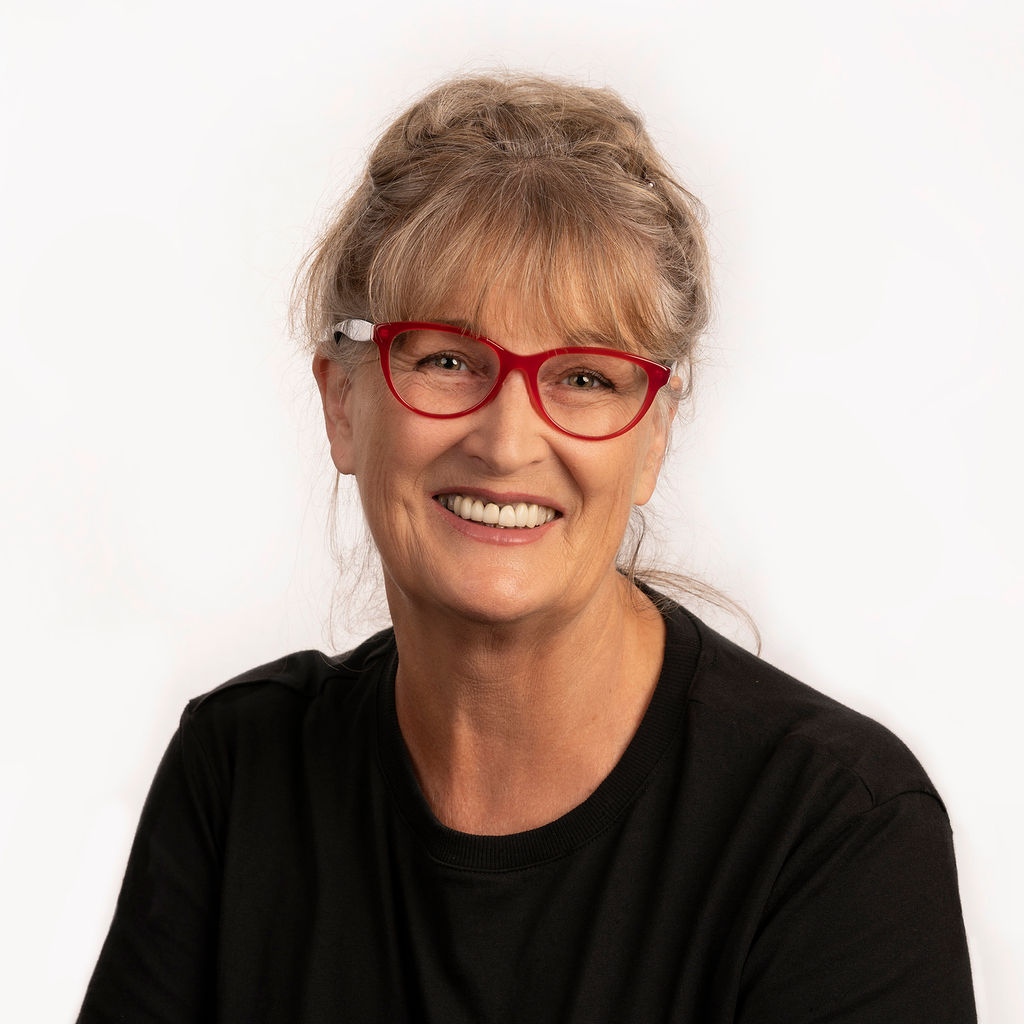
Ever wondered what it takes to write a gritty thriller? As the title suggests, Sister Butcher Sister features sisters and gruesome crime. In this discussion with author K.D. Aldyn, we delve into her inspiration, her unique nomadic lifestyle and the impact of writing violence.
Sister Butcher Sister is not K.D. Aldyn’s first published work. Under her real name, Karenlee Thompson, she has also published Eight States of Catastrophe, a novel about a guy traveling around Australia on a motorbike with a dog and Flame Tip, a collection of short fictions based around the Tasmania bushfires in 1967 that won ANZ Litlovers Book of the Year.
Can you please share the blurb for Sister Butcher Sister?
Three sisters. One killer. Which one is SHE?
The Rowling sisters have always been people you can understand – with partners and children, homes and dreams. And secrets; the sisters have those, too. But when Kate, the eldest, finally returns to buy her late grandfather’s home, the dark things each sister has kept buried soon rise to the surface.
Is Kate having unexplained visions tied to a past she can hardly recall? Is Aurora, the married mother of two, finally acting out in the face of her sisters’ indiscretions? Is Peggy, the youngest and a recovering addict, able to move on from the memories that haunt her?
And then there’s SHE.
SHE is one of them, but SHE is not like them at all. SHE is defined only by the carnage she lets the world see, the murders that have swept through their coastal community. And as the police close in on their newest serial killer, scrutiny lands on the Rowlings, forcing them to face their demons and reveal all they have kept hidden.
Can you ever truly recognise the evil around you?
Have you always been a writer?
Not full time. I’ve done many different jobs. I’ve been a Practice manager for a solicitor and managed a transport company. I have qualifications in journalism but only freelanced for a short while. Hubby and I owned an organic farm in Queensland, supplying organic markets in Sydney, Melbourne and Adelaide with our heritage apples, figs, persimmons and stone fruit.
Now I’ve retired, I can write between traveling. I have all day, so I can slob around in my PJs, which I just love, and really inhabit my current book without having to deal with real life.
Your lifestyle and travel sound amazing. Can you explain how this works?
My husband and I sold up seven years ago, leaving just one tiny plastic box in storage. We do house and pet sitting for people around the world. No money changes hands, but we get to live in the area and get to know the locals. We aim for long term sits, but take some short term sits to fill the gaps. In the country, we generally like to look after dogs and horses, the odd alpaca or ten. Cats are our go-to in cities like London and Paris; it’s much easier to get out and about exploring.
We’d travelled in Australia when we were young but not overseas, so we’re like teenage backpackers in reverse.
Where have you lived this way?
We’ve done some sits in Canada, US, rural France, Bulgaria, but most often we are in the UK, as they utilise this system more than other countries. We’ve stayed in some beautiful old mansions, almost like castles. We do a lot of return sits; sometimes we’ve been back three or four times, so we make friends and fall in love with the pets.
We’ve done one in York with no pets but a beautiful old house. I love that lifestyle, where we can go for walks and stumble across an old pub where there’s fire going.
Currently, we’ve been in Australia longer than usual. We’re cat-sitting in Melbourne for two months, after four months in Brisbane, and we head back overseas in January.
Do you ever find yourselves homeless?
Normally, we’re booked out twelve months in advance. We give ourselves some gaps to have a holiday. Recently, we went to Iceland.
During Covid, we had a cascade of cancelations in the UK. We were in Scotland, where they didn’t have lock downs, but then were booked for Ireland. We went there earlier than planned before they went into lock down.
It’s a great lifestyle for a writer.
What inspired you to write Sister Butcher Sister?
We used to have wild dinner parties, and one night, we discussed Shane Stevens’s book, By Reason of Insanity. Everyone argued you couldn’t write a convincing female serial killer in the way that Stevens had written his male killer. Fueled by wine, I drummed the drum for the feminist cause, and it snowballed from there. My original intent was to show that a woman can, indeed, make a fine serial killer.
Did you change much between your first draft and publication?
Like many writers, I submitted an early draft and got a rejection, so I thought, ‘Oh, that’s it then,’ and it went in the bottom drawer. With experience comes the knowledge that even twenty rejections doesn’t mean a manuscript isn’t good, but it was a long time ago, and at that stage, I didn’t have any experience in the writing world. I only brought the manuscript out again when my agent asked if I had anything else and said he’d have a look. I updated it to include texting and technology, and to remove some outdated references.
A funny thing happened in this rewrite. I had originally based the house and garden on my grandparents’ house, which I loved the house, having spent much of my childhood there. One of my main characters was purchasing that house – number thirty – as a gift for herself for her thirtieth birthday. It occurred to me much later that people who knew me might think something terrible had happened to me in that house, which was definitely not the case, so I changed the house number from thirty to thirty-six. Seems like a simple thing, but it required considerable rewriting. Years later, after I’d dragged the manuscript back out, my sister and I went for a trip down memory lane, only to discover that the area had been subdivided and the number of the house that used to belong to my grandparents had been changed from number thirty to number thirty-six. No way was I going to rewrite again. Anyway, I figured the universe was telling me it was perfectly fine as it was.
After the manuscript was picked up by a US publisher, I did a considerable amount of rewriting to make it more American. During the pitch Zoom, the editor asked if I’d mind altering a few things to make the story more relatable for Americans. She said: ‘We Americans are a funny lot, we like to think the people we are reading about could live next door, although, in this case, heaven forbid!’ It gave us a good laugh.
I changed hemispheres and chose the West Coast – somewhere near California – as a vague unnamed setting; there was less to change than if I made setting somewhere like New York. I changed the garden and altered the seasons. I also had to remove all my Australianisms. Until then, I never realized how many colloquialisms I used. Even after I tried to make my subsequent manuscript more universal, they picked up things I didn’t realize were Australian.
Sister Butcher Sister is a powerful title. How did that come about?
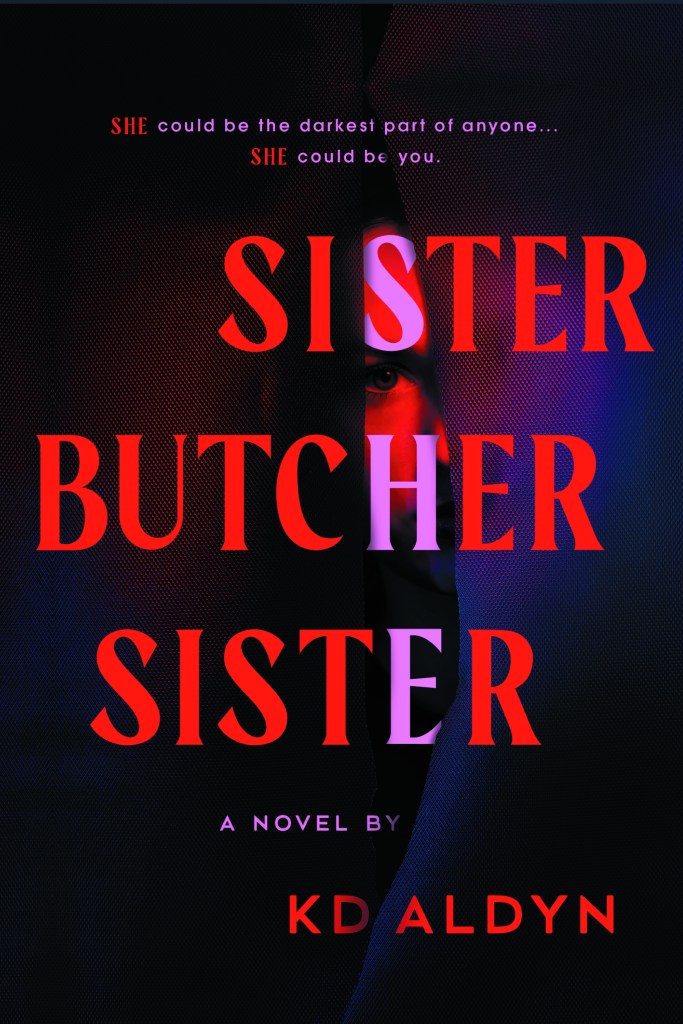
My working title for a series was THE UNRAVELLING, with the first book being SHE. As soon as Sourcebooks/Poisoned Pen Press suggested Sister, Butcher, Sister, I heard it like this: Sister BOOM, Butcher BOOM, Sister, BOOM, like the opening of a movie or a Netflix series. I totally fell in love the [now award-winning] cover, designed by Erin Fitzsimmons for Sourcebooks. The way Erin had picked up the letters of SHE as a nod to the original title really got to me. Made my cry, in fact.
The book has a trigger warning for violence. Was the violence hard to write?
I wish I could say yes, but it wasn’t. We women get used to reading about lots of violence towards women, so in this, I twisted the genders. From memory, it came quite easily. Still, I do always make sure that I read gentle literary works and poetry when I’m writing this type of crime fiction to help me come out of that world.
Quite a few people said it wasn’t as violent as they expected. Others asked how I could write it, so it depends on the mood of the reader, I think, or on what they are used to reading.
A couple of times in planning subsequent novels, I’ve asked friends about what they would do in a situation, and it’s amazing how quickly even mild mannered people can come up with ways of torturing or killing people.
The book has fabulous twist and turns. How did you plot it?
Prior to this book, I’ve always had structure first and spent a lot of time on historical research. This was the first time I went to being a pantser (ed: a pantser means a writer who ‘flies by the seat of their pants’, versus a plotter, who plans everything first).
The story evolved as I wrote, which was liberating. I had no idea who the killer was, so I was writing to let the characters emerge and for the killer to reveal herself. At the start, it could’ve been anyone. I still didn’t know which sister would be the murderer until the last couple of chapters, after which I went back and changed a few things to ensure I didn’t give the game away.
I asked early readers to report back who they thought did it and it worked because there was a lot of flip-flopping between characters. No-one could be sure until very near the end.
Do you have sisters?
Yes, I have two sisters, so there are three of us, like in the book, but to the best of my knowledge, none of us is a killer. The characters aren’t based on my sisters but on elements of me, personal things I like to write about.
When I was thinking about writing the book, the sisters’ names came to me in a dream. That often happens when I immerse myself in an idea. I keep a pen and a pad beside the bed and hope that in the morning there’s enough of a scrawl to read what I wrote.
What are you writing next?
I’m at the copy edit stage for the second of the novels in my two-book deal with Sourcebooks, You Girls Play Nice. Like the first book, this one is a tense psychological thriller, straddling a morally grey line.
It’s about five friends. One is brutally murdered and the remaining four fantasise about murdering the man they know is the killer. Things get messy when someone decides to replicate the hypothetical murders.
Again, while I was writing it, I didn’t know who was guilty until right near the end.
I have two other manuscripts about ready to fly off. They are more literary works under my own name Karenlee Thompson. I chose KD Aldyn to differentiate so that the expectations would be clear to readers.
You can follow K.D. Aldyn/Karenlee Thompson on:
Website: www.kdaldyn.com
Facebook: Karenlee Thompson Author
Insta: Karenlee Thompson-KD Aldyn
Booksales link: Sister, Butcher, Sister by KD Aldyn – Penguin Books Australia
Next time: Christmas Book List 2025
Next Interview: Interview about my short story, The Value of a Sapphire
 Brightside Story Studio
2 thoughts on “K.D. Aldyn on writing gritty thrillers”