
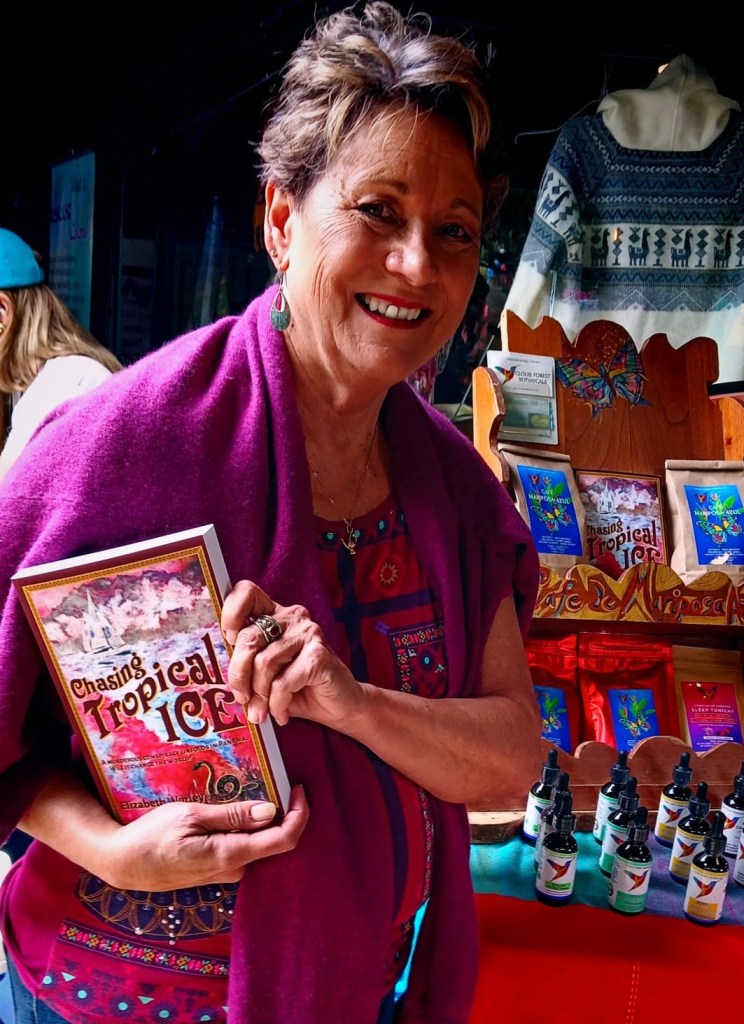
After growing up in the Blue Ridge mountains of North Carolina, getting married young, having kids, and generally checking all the boxes, at 50, Elizabeth rescripted her life: moved to Panama, bought a coffee farm, came out as gay, and became an author. She’s entertaining, forthright, and an all-round delight. Join me in chatting with Elizabeth about turning her life upside-down and her dramatic debut novel Chasing Tropical Ice.
Can we please start by sharing the book blurb for Chasing Tropical Ice?
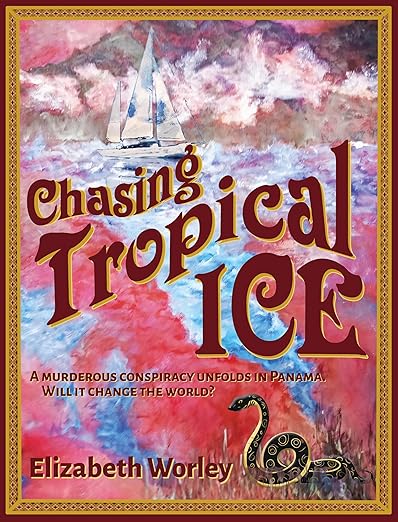
In the highlands of Panama, a jungle conspiracy turns deadly—and two women are caught in the crosshairs.
All Augusta wanted was inspiration. All her partner Kaye, a retired Air Force pilot, wanted was a quiet escape. Instead, they stumble onto a deadly smuggling ring—and a woman who’s vanished without a trace. Powerful men will do anything to keep the truth buried. Now Augusta and Kaye are targets.
But not all power belongs to men. One uber-powerful woman—an arch-villainess in her own right—may be the only one who can turn the tide against them. But at what cost and to whom?
Murder, greed, and corruption thrive in these mountains—shielded by silence and fear. But Augusta and Kaye aren’t backing down. If they fail, the truth dies with them.
A gripping feminist thriller packed with mystery, suspense, and sharp social insight, Chasing Tropical Ice delivers strong female protagonists, deadly intrigue, and a setting as dangerous as the secrets it hides. A must-read for fans of LGBTQ+ thrillers, morally complex heroines, and feminist noir fiction.
Some secrets are buried deep. Some fight their way to the surface.
Congratulations on this powerful, entertaining, and thought-provoking novel. The theme of patriarchy and male violence is central to the story. How did you form your opinions about this?
My thoughts have been forged by living life as a woman in our times, studying history and culture, from conversations with other women, my master’s degree in therapeutic counselling, and years working in the field of domestic violence.
Back in the 1990s, I was the executive director of a domestic violence and sexual assault program in western North Carolina, one of the first to operate an emergency shelter. I conducted training around the state for other workers and volunteers. Later, I taught at university, then moved into private practice, where I ended up concentrating on sexual abuse survivors and people questioning their gender orientation and sexuality.
I have two grown sons, who I love dearly, and many male friends, but it doesn’t mean I’m blind to the pattern of male violence. Who starts wars? Who holds the wealth? Who has the most to lose if the system of patriarchy changes? A few men in my acquaintanceship have distanced themselves from me as result of publishing this book, but I’m too old to worry about that. The facts speak for themselves, even if it is uncomfortable.
The fabulous setting, the highlands of Panama, is now your home. How did you end up living in Panama?
When I turned 50, in 2001, I took myself to Italy, alone. Although I don’t think I put it this coherently at the time, I was struggling with an incongruence in my life; something wasn’t matching up. Much to my husband’s dismay – my daughter was 14 and my sons were grown – I set off, wanting to learn who I was away from everything and everyone. I studied painting and cooking and architecture with my rudimentary Italian.
This was before 9/11, and I became intrigued by how people in Europe viewed the US, astonished by what a negative viewpoint the Italians had. They were genuinely baffled that there was no universal health care, that the US routinely got involved in foreign wars, that the Equal Rights Amendment had never passed. I began to question my commitment to remaining in the US. Life elsewhere seemed enticing, freer.
I cried when it was time to go home. I flew back wondering what people who leave the US do. Where do they go? How does that happen? How does one become an expat?
I started researching. Italy was my first choice, but not easy to do. I saw that people were going to Croatia, New Zealand, and Panama. I didn’t know anything about Panama except they have a canal and mosquitoes!
By now it was after 9/11, and the US had invaded Iraq. After a lifetime and career of social activism, I despaired. I wanted out.
I was in the midst of a big program at work. I’d raised millions for housing for survivors of domestic violence and was talking to the head contractor. He’d invested in real estate on the Caribbean coast of Panama and was going down and said I should come.
In Jan 2002, my husband and I flew to Bocas del Toro. It had a jive and hustle vibe, with reggae influence. Very groovy. Unpaved streets, boat taxis to distant islands, palm trees, but it was hot and steamy. I don’t do hot and steamy – at least not in the weather!
Some folks we met said they owned property in Boquete, up in the highlands. I said I didn’t come to buy property. They said, “Just look.”
We drove up a dirt road, more of a riverbed, for about 45 minutes. I walked into the jungle on an abandoned coffee farm named Finca Luz (Light Farm). I was sure there were snakes and spiders. I knew this was where I was meant to be, here on the side of the volcano in Panama.
We bought the property and moved there full time in February 2004.
I was becoming clearer and clearer it wasn’t just the US I wanted to leave. My marriage had been dysfunctional for years, and I wanted out of it. A huge reason was that I was finally accepting that I was attracted to women.
In Boquete, I met and fell madly in love with Dianne. That was the tipping point for ending my marriage and jumping into the unknown. We have been partners for the last twenty years.
While your lived experience has informed much of the story, what elements required more research?
I have never been on a mega-yacht, or a charter plane, or met a pufferfish. There was a lot to learn. Thank God for Google and the internet! I reached out to people in various industries, talked to lots of expats (Boquete is a diverse community) and most everyone was really helpful. The rest is what fiction is all about: creating a reality that may or may not exist in the real world.
When did you first start writing? Can you please tell us a bit about your writing life?
I’ve been writing since I could hold a crayon. I wrote my first short story, ‘La Blanca, Wild Stallion of the West,’ in 3rd or 4th grade with a green ball point pen on foolscap paper with big lines. Being only nine years old, I didn’t know that a stallion, being male, would have been El Blanco. I needed a good editor even then! I can still remember that green ball point pen.
My favourite part of high school was being assigned to write book reports or essays in English class. At 15, ,y first job was co-editor of a weekly summer mimeographed newsletter in Highlands, NC, called The Galax News. To get the job, I had to teach myself to type on a 50-pound upright typewriter. I topped out at 25 words a minute! I wrote short snippets about who was visiting whom at which parties in this snobbish resort town. Some accounts were fictional.
I always enjoyed researching term papers in university but usually put off writing them until the day before they were due. The adrenaline rush of creativity!
Professionally, I wrote journalistic and personality profiles for regional, state and national magazines – until I realized I would starve and starve my two children if I didn’t get a real job. I transitioned to writing educational pieces about domestic violence, grant applications, and newsletters.
Chasing Tropical Ice is your first novel, but not your first book. Can you tell us a bit about your memoir, Risking Everything: Coming Out in Coffee Land?
One evening, Dianne and I were having a cocktail and watching the sun go down, when I said I’d always wanted to write a book, but I’d never known what to write about.
She said, “Are you crazy? Write your story!”
The first draft poured out in six weeks – a raw, uncensored account of my life and relationships. It was cathartic.
Dianne’s sister, Australian author Lisa Heidke (Darcy), was the first person to read the first draft. She and a few other beta readers gave positive, constructive feedback. I put it aside for 8-9 months, then brought it back out, rewrote parts, and went the self-publishing route. I’d been around the publishing world enough to know I didn’t have time to mess around with finding a traditional publisher. I am proud to say it won a Global eBook Award for best memoir.
How did you decide what genre to write next?
I’ve always loved spy thrillers and mysteries and wanted to write a grown-up Nancy Drew mystery like the ones I’d read as a child. Nancy, in her little red roadster, her friends George, and Beth, and the irrelevant boyfriend. I started thinking, what if Nancy Drew grows up, comes out as a lesbian in Panama, and solves mysteries? With a partner modeled on George (who was christened Georgina, as I recall).
I started Chasing Tropical Ice working with a small circle of writer friends. When I was about 60% through it, COVID hit. I had dead bodies scattered all over the beach and didn’t know what to do with them, so I stopped and set it aside.
About 18 months ago, a friend from my writers’ group who’d read one of the earliest drafts cornered me in the airport and challenged me to finish it. I thought, well, okay. I rewrote it, had beta readers, and edited it again. When I was happy with it, I published it.
Do you have any tips for authors?
If you have the urge to write, just do it. One word after another. Don’t worry if they are not perfect words. Just get it down. You can always rewrite.
Read about writing. There are lots of online resources. I am currently subscribing to Master Class and following some of my favourite authors, including Margaret Attwood, for great tips and insights.
Residential workshops are wonderful and my wife’s sister, Australian Lisa Heidke, teaches a week-long workshop each year in Tuscany. Nothing inspires like being in the company of other writers with a great plate of pasta and a glass of wine!
You have a story to tell? Tell it.
What’s next?
My sister, Mary Lou Worley, a librarian and voracious reader, read Chasing Tropical Ice and demanded to know when the sequel was coming! So that’s where I’m at. It will be out in 2026 and promises to be explosive!
Is there anything else you want to add?
I am blessed in my life, my relationship, and having the time to create. Once I finish the first draft of the sequel, I will do a painting that will be the cover for Chasing Arctic Fire (just as I did for Chasing Tropical Ice). Life is good.
You can follow Elizabeth on:
Website: www.chasing-tropical-ice.com
Facebook: chasing.tropical.ice
Insta: chasing.tropical.ice
Goodreads: Chasing Tropical Ice Goodreads
Email: elizabeth@elizabethworley.org
Booksales link: Chasing Tropical Ice Amazon
Next time: an interview with the fabulous Margaret Colville Attley OAM on the joys and challenges of community work.
 Brightside Story Studio
4 thoughts on “Elizabeth Worley on life in Panama and Chasing Tropical Ice”