
Interview by Sophia Voukelatos.
Diane Clarke, known for writing family dramas exploring secrets and complex relationships, has just published her second novel, The Bracelet. We discuss her writing process, inspiration, her stunning cover designs and more.
In your previous interview about The Photograph, you said that while you immigrated to Australia from the UK some time ago, you still write about the UK. Why do you think that drive is so strong?
I am quite sure I could set a story in Brisbane, where I know locations, the weather, the way of life. As much as we’ve tried to actively integrate into Australia, I am less confident to write about the culture of another country. I don’t want to write something about Australia that comes across as inauthentic to someone who’s lived here all their life. Nevertheless, because we’ve been here for nearly thirty years, I do find I have to stop myself sometimes and consider ‘is this a British or Australian expression?’
Is the UK still home?
No, I do feel as if Australia is home, but I am more comfortable writing about the UK.
You also mentioned that you’re a speech pathologist. Can you tell us a bit more about how this expertise influences your writing?
One of the core tasks of a speech pathologist is to be a great listener and observer. A lot of communication is transmitted non-verbally. My training to listen and observe has given me an ear for dialogue and an eye for interaction, recognising that communication is a dynamic, collaborative process between two or more people. The challenge is to find the words to capture both the spoken and non-verbal cues on paper. Having experience as a speech pathologist feels a bit like having a head start.
Do you prefer writing dialogue or expressing non-verbal communication?
I do love dialogue, but I love both aspects of a scene. My characters come to life in those moments, like watching a movie play out, and they sometimes take off in a direction I wasn’t expecting.
One of the things I’ve had to learn is if you comment on every single body movement, it can slow the dialogue or pull the reader out of the story. In my first draft, the dialogue reads more like a screenplay, describing every eye roll, every twitch, et cetera. I’ve learned that you need to decide which are the most important ones.
Have you ever had any desire to write a screenplay?
I guess its everyone’s dream to have their novel turned into a film. But while it interests me, I’ve been too busy to tackle another style of writing.
Can you please share the blurb for The Bracelet?
Monica Grainger’s life is upended when Harry Powell, the man she believes is her father, fleetingly appears at her grandma’s funeral. In the hope of understanding the past, she negotiates a truce with her prickly tight-lipped mother, Celia, and re-examines a decades-old tragedy involving Harry’s sister.
Just as Monica finds the courage to reach out to Harry, Celia gives her a silver bracelet that triggers alarming questions.
As she unravels the mysteries of the bracelet, her mother’s behaviour alters. Will these puzzles derail her dreams of connecting with Harry and his family?
Why did you choose a bracelet as the item of jewellery to link to the mystery?
Inherited jewellery always comes with a history whether it involves a simple family story or something more mysterious or surprising. This second example is often a key feature in novels and, no spoilers, but it may be the case in my story too!
I’ve also incorporated the idea that Monica’s bracelet symbolises connection. Initially, Monica sees it as a way of connecting to her mother and grandmother.
Why do you choose to write about secrets and complex family dynamics?
We all have secrets in our lives and, for me, these go hand-in-hand with lies and omissions. Some of these, such as white lies, are relatively harmless in my view because they are often told to be kind – to not hurt someone’s feelings and to make their lives less difficult.
Everyone has their own red line in terms of what they see as acceptable and what is not. We are all challenged by that at some point in our lives, and it’s the fodder of fiction – something that’s written about all the time to give mystery and suspense. I’ve been inspired through reading great novels and seeing how secrets drive the characters’ actions.
Do your characters grapple with their own and others’ ‘red lines’?
Yes, the characters definitely grapple with secrets, what behaviour they deem is acceptable and uncertainty over what they share with others. Monica’s mother, Celia, discloses to Monica that she was forced to keep secrets. Another character doesn’t want the truth told because he’s worried about his wife and family. One of Monica’s friends is unsure whether or not to tell Monica some information that turns out to be really important to Monica’s quest.
Monica’s mother has early onset dementia. How important is this thematically? Why did you go down this path?
It is important in a number of ways. It adds a layer of worry and complication for my main character in terms of what is going on with her mum – why Celia is behaving like she is.
I also wanted to write about dementia in an authentic way, particularly the confusion that often arises when a person’s behaviour first begins to change. I have talked to many family members who report this as one of the most difficult aspects of the disease.
For you, is writing a therapeutic or cathartic process?
Yes, certainly for this book. I felt compelled to share my experiences of my mother’s dementia to get some pretty awful experiences on paper and out of my system. The original draft was, in all honesty, a bit too heavy on that.
For people starting off writing, there is a perception that the writer begins with a fixed plot. However, from my experience with both my books, that was not the case at all. So, in the initial drafts, there was a lot about Celia’s struggles with dementia, however, in the final manuscript much of that was cut out to keep the focus on Monica’s journey.
What else inspired you to write The Bracelet?
Like The Photograph, the themes of identity and belonging are central to this novel.
Growing up on the Sussex coast served as an inspiration for the setting. The lonely, winter beach scenes provided a perfect backdrop to Monica’s early life in the beachside town of St Leonards.
As far as Monica’s career in theatre, I belonged to a drama school as a teenager and hope I have done justice to her career and work surroundings.
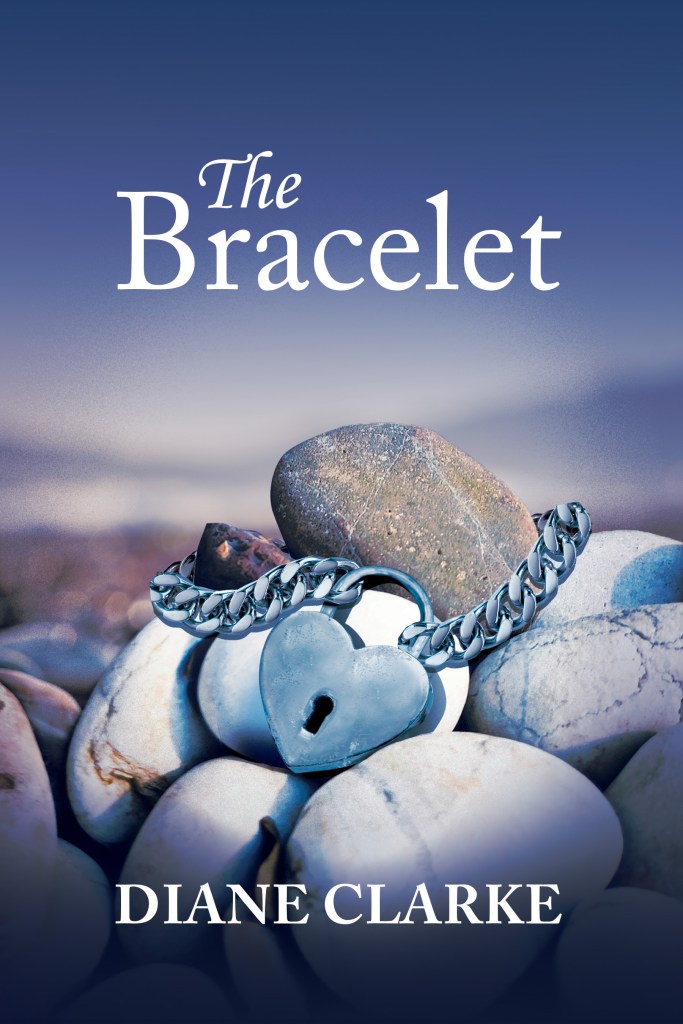
The cover for The Bracelet is beautiful, so is The Photograph. How much input did you have?
I was really lucky. An author friend gave me advice about presenting the publisher’s in-house cover designer with some image ideas. During my search, I came across an artist from the UK who had beautiful, evocative artwork from the WWII era, and I was able to commission him to produce the cover for The Photograph. It meant I had a lot of input, although it was almost perfect from the word go. We just had to tweak the artwork to represent the family in the story.
For The Bracelet, I used a different designer and initially I gave him two really strong ideas. The first was to have a bracelet in a box under a spotlight. However, when I saw his image of the beach scene, I could have cried, it was so perfect. The designer did an excellent job with perspective, ensuring the focus remained on the bracelet and didn’t get lost in the beach setting.
It must be lovely to build relationships with other creatives.
Yes, covers are so important, and I feel lucky to have had so much input. I know from other authors that this isn’t always the case.
How has your experience working with a literary agent and mentors shaped the outcome of the novel?
Very early on, I joined a writers’ critique group, and they knocked all the rookie errors out of me. I also attended courses and workshops to educate myself and become a better storyteller. But it was being picked up by an agent and having the skills of a professional editor, who worked at every level, from structural to copy editing, that took my writing to new heights; it springboarded me to the point where I eventually got a publishing deal.
How many beta readers read your most recent manuscript?
The Bracelet was read by a six-person beta panel associated with my literary agency. I was also involved in a manuscript swap with another author, which was really useful.
How do you find getting feedback from so many people? Can it be overwhelming?
Because I’d previously belonged to a critique group, I was used to managing feedback, and I’d got over myself to a degree! As a rule of thumb, if two or three people comment on the same thing, you know you need to pay attention.
What’s next in your writing?
I have an early novel, which has characters I’m very fond of, so I am not sure whether I will work on that. It is in a different genre, crime, so I am uncertain whether it might be better to stay in my lane. For now, I am focusing on the launch of The Bracelet.
You can follow Diane on:
Email: dianeclarke@iinet.net.au
Website: www.dianeclarkeauthor.com
Facebook: DianeClarkeAuthor
Insta: Diane.Clarke.Author
LinkedIn: Diane Clarke
Threads: diane.clarke.author
Booksales link: https://amzn.to/3Ll39HM
Next time: an update on my writing journey A dead end … not The End.
Next interview: conducted by Sophia Voukelatos with Rosie Schonell on her debut novel Breaking School Rules is Easy.
 Brightside Story Studio
One thought on “Diane Clarke on The Bracelet”