
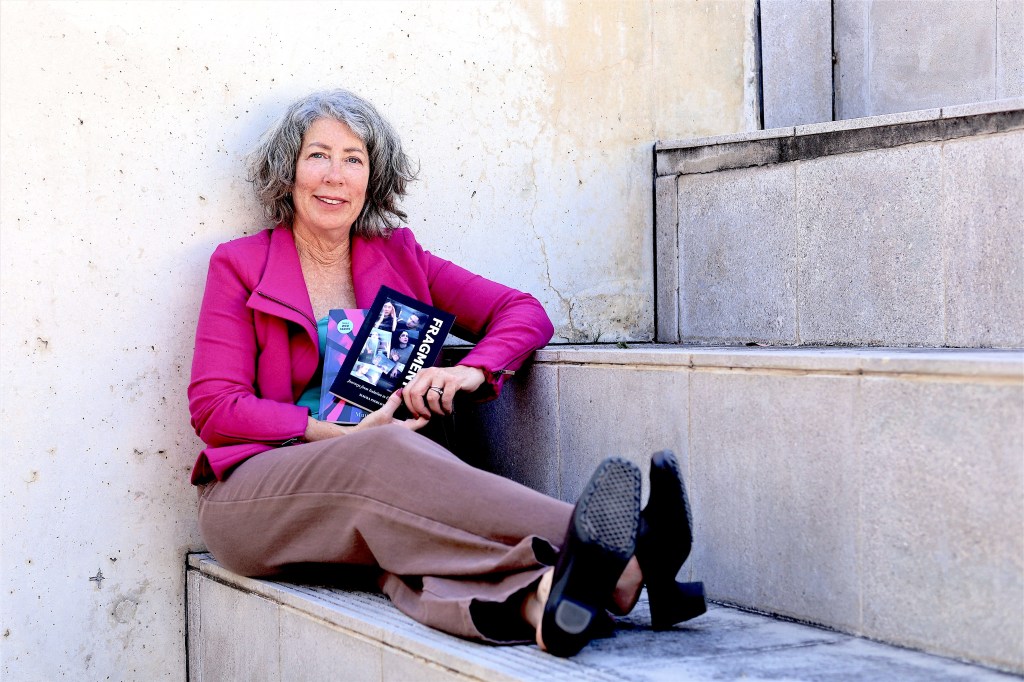
In our last interview, author and playwright Maura Pierlot discussed launching Fragments, a play about youth mental health. Maura’s latest venture is a nonfiction picture book, What Will You Make Today? Today, we discuss what inspired her to write this book and the benefits and pitfalls of changing genre.
Can you tell us a bit about What Will You Make Today?
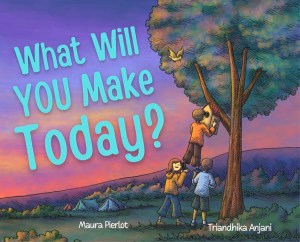 It’s a 32-page creative non-fiction picture book, beautifully illustrated by a young Indonesian artist, now based in Canberra, Triandhika Anjani. The text is deliberately sparse, posing a series of questions: Will you make your bed? Will you make friends? A discovery, a decision, a team, a plan? The children end up finding and fixing a problem, learning from their mistakes and their gaze shifts, leading them to think: what else can I do?
The story is designed to highlight that kids have agency, albeit in a limited sense as parents are presumably in the background. However, there are no parents in the book because I wanted this story to very much be about children engaging with each other and their environment, and making decisions. At the end of the story, I explain the ‘six C’s’ that the characters display: citizenship, character, creativity, collaboration, communication and critical thinking. Kids need skills like these today and in the future.
Where did the inspiration for this book come from?
During my childhood in the 60s, the Bronx was a city where you grew up fast. It was a different era – adults set the agenda, and children just did what they were told. I was a curious kid with a lot of confidence, but adults typically discounted my ideas and plans (“Maybe when you’re older”) as though I could only ‘reach for the stars’ when I turned eighteen. Patience has never been one of my virtues, so I went about doing things anyway and was always getting into trouble.
More recently, when reflecting that the future is in children’s hands – I know that’s a platitude, but it’s true – I wanted to empower them, to help them understand that literally your smallest actions and choices can have a profound effect on you, the people around you and the whole world.
The text is unusual being all questions. In picture books, the narrative is usually declarative, sometimes exclamatory or imperative, but to me, that’s the problem with a lot of books. We’re telling kids how to think. I wanted this story to be interrogatory – a gentle, inviting, open-ended inquiry. A book that makes children think.
The answers aren’t as important as the questions. That’s my philosophy in life, too. Philosophical questions anchor our lives: Who are we, why are we here, what is the good life? The arts can navigate this territory well, but most people still see the arts as somewhat nonessential. They watch a film for entertainment or get lost in a beach read; they’re not turning to art, film, literature or theatre to make sense of their lives. Not surprisingly, there’s been a ‘dumbing down’ of content to appeal to the masses and the kidlit industry is arguably the most competitive and commercial sector. My work isn’t zany. It doesn’t come with a plush toy. I don’t have crazy hair or play the ukulele. For what I write, I assume an intelligent audience, by which I don’t mean intellect but curiosity. Children who don’t want to be spoon-fed answers. That’s probably a niche market right now, but one that I hope grows exponentially because the world is becoming increasingly complex, and we need good thinkers.
What are the benefits or pitfalls of writing in different formats and genres?
I’ve always loved words and wordplay, and my interests have always been eclectic and far-reaching. Growing up, I’d tell people I wanted to be a dilettante, thinking that was a good thing. (It sounded fancy!) I always thought my versatility was a strength, but later in life, I wonder whether some people think I just can’t commit to one thing. They want to know “What are you?” But I’ve never wanted to be just one thing. I don’t feel the need to fit in one genre. In fact, I can’t think of anything worse. You can get typecast as X, Y or Z, but why can’t you be X, Y and Z?
I’ve enjoyed many successful careers that involved writing for other people – legislation, ads, health policy, ethical analysis – but I focused on creative writing as a priority only about ten years ago. I write for children and adults, typically about existential issues (the nature of self, identity, belonging) and, recently, about mental health and wellbeing. I’ll write in any genre because in a sense, I’m writing for myself – to make sense of the world. Writing makes me happy.
The arts industry is highly marginalised – you spend ages producing a work and then hope people engage with it and tell their friends. Fragments enjoyed a sell-out theatre season in 2019, but that’s only about 400 people. Years of writing, months of preproduction and that’s it. Perhaps it’s my business background, but I was determined to broaden the reach and impact of this work so, with a healthy dose of versatility, I leapt into the world of adaptation, convinced that the ability to sit above your material and see its potential is a strength.
What have been some of the responses so far to What Will You Make Today?
The book has been very well received with wonderful reviews and opportunities, school visits and so much positive feedback from children, families and teachers. When I meet children to talk about the book, I ask them, “What will you make today?”
One child smirked and told me, “I will make trouble.” I liked that kid. Gadflies of the world, unite!
One boy, who looked like a deep thinker, took a long time to answer. After the pause, he said, “I will make a sandwich.”
A young girl told me, “I will make a blanket for my baby.” It turned out her mother had given birth recently, and this child had really bonded with the baby and saw her as her own.
Another child told me, “I will make myself proud”. Music to my ears.
Can you give us a quick update on Fragments?
Fragments has evolved from a play (live performance and published playscript) to a young adult novel, to an award-winning web series and now to a feature-length film doing the festival rounds. I recently co-wrote lyrics for a song based on one of the Fragments monologues. The song is called ‘Stay’ (the artist is The Profit, featuring Sophia Marzano) and can be found on Spotify here: https://spoti.fi/3pGnW1c I exec produced the music video which will drop any day now. For anyone interested, the web series can be viewed on YouTube: https://bit.ly/BigIdeasPressFragmentsPlaylist.
What next?
I’m working on a memoir, so adult nonfiction. It’s about the messy issues at the intersection of identity, belonging and mental health. There’s a fine line between fiction and nonfiction. Do you ever really know yourself? How reliable is memory? I have a writing fellowship coming up in Perth, where I’ll be working on it.
You can follow Maura on:
Email: maura@maurapierlot.com
Website: https://maurapierlot.com
Facebook: maurapierlotauthor
Insta: maurapierlot_author
Twitter: maurapierlot
Booksale link: Booktopia
Next time: read about my publishing deal in The Enormous Difference Between BUT and AND
Next interview: Timo on his IT Thriller, The Scaevola Conspiracy
 Brightside Story Studio
2 thoughts on “Maura Pierlot on the pros and cons of changing genres”